Mon-Fri 4:30AM-10:00PM | Sat-Sun 6:00AM-8:00PM

A kids’ fitness class can look good on paper and still leave a lot of practical questions unanswered. What actually happens during class? Is the pace manageable? Will the coach know how to support a child who feels nervous, distracted, or unsure where to start?
The best homeschool PE classes give families in Vacaville a clearer sense of what to expect before the first session begins. Look at the class format, coaching style, activity variety, and overall atmosphere so your child has a better chance of walking in prepared and leaving with more confidence. Read on for practical tips on choosing a physical education class that fits your homeschool routine and your child’s needs.

Parents should ask questions that reveal how the program works in real life. An active class can still feel confusing if the age range, coaching style, safety expectations, or daily format aren’t clear from the start.
Age matters, but it’s not the only thing to consider. A younger child may be energetic and ready for group games, while an older child may feel hesitant if they haven’t had much structured fitness experience.
Luckily, there are many PE activities that fit different energy levels, from quick station rotations to shorter skill rounds and gentler movement options. The right class should be able to use that variety without making children feel separated by ability.
A good fit gives kids room to:
Parents should ask what children actually do during class. A strong physical education program should offer more than open play by helping kids build motor skills, knowledge, and behaviors that support physical activity and fitness.
A balanced session may include cardio, agility work, sports skills, conditioning, coordination drills, teamwork, and playful challenges. Mini games, cones, obstacle courses, agility ladders, and beginner sports drills can all help children build different abilities without making the class feel too formal.
Variety keeps kids engaged, but it also supports fuller development. One activity may build stamina. Another may improve balance. A third may help children practice teamwork, listening, or body control.
Some children jump into a group right away. Others need to watch first, ask questions, or start with a simpler version of the activity. Finding something that suits your child’s personality helps, but the class itself should still be flexible enough to support different comfort levels.
That balance is part of a strong youth physical education class. Clear instruction, age-appropriate activities, positive coaching, and enough flexibility for children who are still building confidence can all help the class feel supportive without becoming too loose or unstructured.
Before enrolling, parents may want to ask:
A good class should have energy, but it shouldn’t feel chaotic. Children need enough structure to understand where to go, what to do, and how to move around others safely.
Safe equipment, clear boundaries, organized transitions, and attentive coaching all help kids relax into the class. When children know what to expect, they’re more likely to participate with confidence.
Parents can often sense this during a visit or trial class. Watch how the coach gives directions, how children respond, and whether the room feels upbeat without feeling out of control.
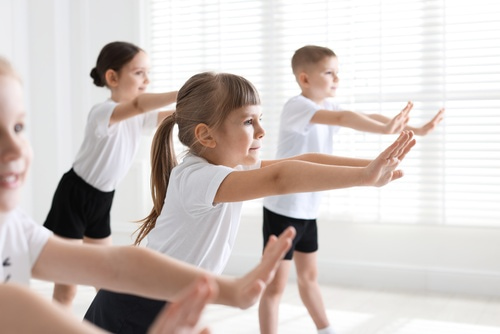
A child who dislikes competitive sports may still enjoy movement when the class gives them room to try, laugh, and build small wins. Instead of relying only on speed, scoring, or team selection, the program should include low-pressure PE activities for kids who aren’t competitive.
Encouragement should show up in the coaching style, not just in the class description. Listen for praise that notices effort, focus, teamwork, and improvement instead of only rewarding the fastest or most athletic child.
Even a great program needs to fit the rhythm of your homeschool week. Parents should consider the class time, location, consistency, and how the session fits around lessons, errands, sibling schedules, and downtime.
It can also help to ask whether there’s a trial option. Seeing a class in person gives parents and children a better feel for the coaching style, pace, and group environment.
A program that fits your schedule is easier to keep attending. Consistency matters because children often build confidence through repetition, routine, and familiar faces.
A strong class should answer the practical questions parents care about before enrollment. Look for age-appropriate activities, patient coaching, safe equipment, flexible pacing, clear structure, and a schedule that works for real family life. The right program should help children move more while making participation feel comfortable enough to repeat.
Maximum Fitness gives families a supportive setting where kids can build coordination, strength, confidence, and teamwork through guided movement. Families come to us from near Peña Adobe Regional Park, downtown Vacaville, and neighborhoods throughout the area for upbeat, organized sessions that help children stay active without making fitness feel intimidating. Reach out today to learn more about our kids’ PE programs and see whether our class feels like the right fit for your family.
.png)